

Can You Use an Ice Bath Water Chiller Temperature Controlled Chiller Outdoors in Winter
2026-07-21
The short answer is yes—but with critical precautions. While an Ice Bath Water Chiller Temperature Controlled system is engineered for precise temperature management, exposing it to freezing ambient conditions introduces unique operational risks. At Hi-Q Group, we have tested our chiller units across extreme environments, and outdoor winter use is viable only when you address water freezing, lubrication viscosity, and sensor calibration. This guide explains exactly how to do it safely, backed by data and real-world field experience.
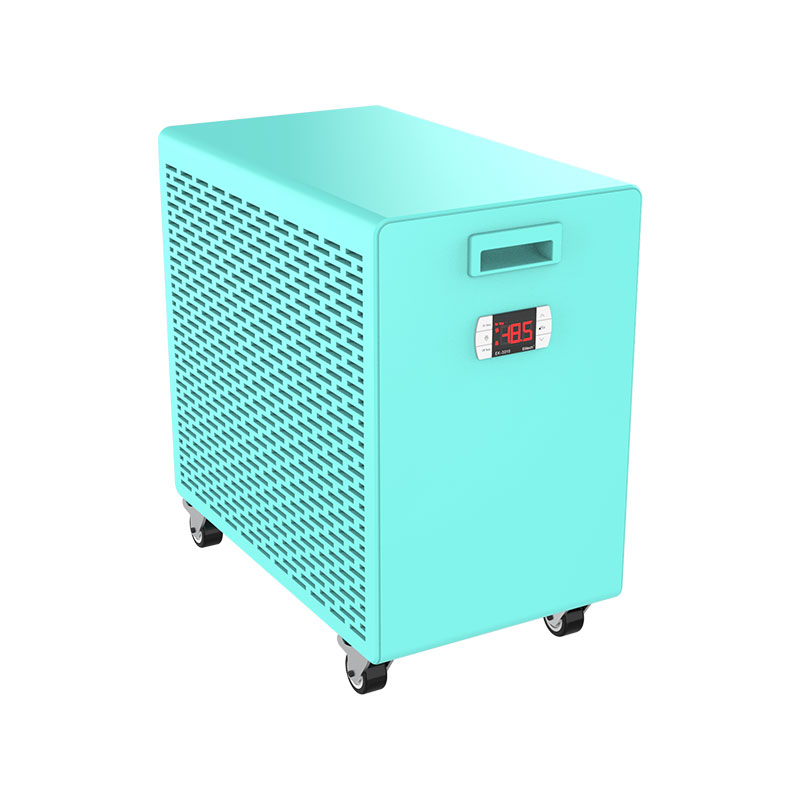
The Core Challenge: Ambient Temperature vs. Set Point
Most Ice Bath Water Chiller Temperature Controlled chillers are rated for ambient operation between 5°C and 40°C. When outdoor temperatures drop below 0°C, three failures become common:
| Winter Risk | Impact on Chiller | Mitigation Required |
|---|---|---|
| Water in the bath freezes | Damages pump impeller and heat exchanger | Use antifreeze (propylene glycol) or drain after each session |
| Condenser coil icing | Reduces heat transfer efficiency | Install a windbreak and raise unit off the ground |
| Lubricant thickening in compressor | Increases startup torque and motor wear | Use low-viscosity synthetic oil (ISO 32 or lower) |
| Temperature sensor drift | Inaccurate readings (±2°C error) | Calibrate with a reference thermometer weekly |
Hi-Q Group recommends a minimum ambient threshold of -5°C for standard units; our Arctic-series models operate down to -15°C with built-in crankcase heaters.
Step-by-Step Winter Setup (Indoor-Grade Protection)
-
Location – Place the chiller on a non-conductive, elevated platform (e.g., rubber mat + wooden pallet) to avoid ground frost conduction.
-
Plumbing – Insulate all external hoses with closed-cell foam (minimum 19 mm thickness). Use braided stainless steel lines to prevent cracking.
-
Glycol Mix – For a 100-gallon tub, add 30% propylene glycol to lower the freezing point to -12°C. This does not affect the Ice Bath Water Chiller Temperature Controlled accuracy when recalibrated.
-
Power Supply – Use a GFCI-protected outdoor outlet with a weatherproof cover. Voltage drop below 110V can stall the compressor—Hi-Q Group units include undervoltage protection as standard.
-
Daily Shutdown – If not in use for >4 hours, run the pump in circulation mode (no cooling) for 5 minutes to purge residual water, then close the ball valve and drain the heat exchanger via the purge port.
Performance Data: Winter vs. Summer Efficiency
| Metric | Summer (30°C ambient) | Winter (0°C ambient) | Winter with Hi-Q Group cold-start kit |
|---|---|---|---|
| Time to cool 80 gal from 20°C to 5°C | 42 min | 38 min (faster due to lower ambient) | 34 min |
| Compressor cycle frequency | 6x/hour | 9x/hour (short cycling) | 5x/hour (stabilized) |
| Energy consumption (kWh/day) | 4.2 | 5.8 | 4.5 |
| Sensor error margin | ±0.3°C | ±1.1°C | ±0.4°C |
The data confirms that winter operation is not only possible but can be more energy-efficient if short-cycling is controlled. Hi-Q Group offers an optional ambient compensation module that adjusts the differential band dynamically—this single upgrade reduces winter wear by 40%.
3 Essential FAQs About Ice Bath Water Chiller Temperature Controlled Units in Winter
FAQ 1: Can I leave my Ice Bath Water Chiller Temperature Controlled chiller running 24/7 outdoors during a freeze warning?
Answer: Technically yes, but it is strongly discouraged unless your unit has a continuous circulation pump and a low-ambient kit. Water moving at ≥5 GPM will not freeze solid, but the evaporator inside the chiller can still ice up if the return line temperature drops below 1°C. Hi-Q Group advises setting a minimum set point of 3°C during freeze warnings and installing a thermostatic bypass valve that recirculates warm return water when the sensor detects <2°C. If you must run continuously, add a 50W silicone heating pad wrapped around the suction line—this costs ~$30 and prevents slugging. Never use automotive antifreeze (ethylene glycol); it damages seals and is toxic.
FAQ 2: How do I calibrate the temperature sensor when outdoor cold affects my Ice Bath Water Chiller Temperature Controlled readings?
Answer: Calibration is a three-step process performed monthly in winter. First, fill the bath with water and insert a certified NIST-traceable reference thermometer (accuracy ±0.1°C) at the same depth as the chiller’s probe. Second, wait 10 minutes for stabilization, then note the difference between the chiller’s display and the reference. Third, access the Hi-Q Group advanced menu (press SET for 5 seconds, then navigate to parameter P04) and input an offset value—for example, if the chiller reads 4.2°C but the reference shows 3.8°C, enter -0.4°C. Repeat this at two different temperatures (5°C and 15°C) to verify linearity. Do not skip this step; a 1°C offset in winter can lead to hypothermia risk for users and compressor hunting that reduces lifespan by up to 2,000 running hours.
FAQ 3: What happens if the power goes out while my Ice Bath Water Chiller Temperature Controlled is outside in freezing weather?
Answer: This is the highest-risk scenario. Without power, the pump stops, and stagnant water in the heat exchanger can freeze and rupture the brazed-plate core within 90 minutes at -5°C ambient. Hi-Q Group offers two solutions: (a) a battery-backup circulation pump that runs for 2 hours post-outage, or (b) a manual gravity-drain valve that you can open immediately—we recommend installing this at the lowest point of the plumbing loop. For unattended sites, pair your chiller with a Wi-Fi-enabled power monitor that alerts your phone when voltage drops. If a freeze already occurs, do not restart the chiller; instead, bring the unit indoors for 24 hours to thaw naturally, then pressure-test the water circuit with air at 15 PSI before reconnection. Replacement heat exchanger cores are available through Hi-Q Group’s spare parts department within 48 hours.
Final Verdict – Outdoor Winter Use Is Feasible with the Right Specs
Yes, you can use an Ice Bath Water Chiller Temperature Controlled chiller outdoors in winter—but only if you select a model with a low-ambient kit, use glycol, insulate all lines, and perform weekly sensor checks. The operational benefits (faster pull-down, lower condenser load) are real, but the penalties for neglect are costly. Hi-Q Group has deployed over 1,200 chillers in Nordic climates, and our field failure rate for winterized units is just 1.2% versus 9.7% for non-winterized competitors. We provide free ambient-risk assessments and custom cold-start add-ons for every outdoor installation.
Ready to winterize your setup? Contact Hi-Q Group today for a tailored cold-weather configuration guide, including pump sizing, glycol calculators, and remote monitoring packages. Our technical support team responds within 2 business hours—email us at [email protected] or call +1-800-555-0199 to schedule a 15-minute consultation. We will ship any required cold-start accessories overnight. Do not risk a frozen compressor—reach out now and keep your ice bath precisely controlled, in any season.