

Cold-Air Nebulization or Other Diffusion Methods: Which Scent Diffuser Machine Technology Fits Commercial Use?
2026-11-11
A brand manager for a hotel group reviews guest complaints from three properties. At the flagship property, guests describe the lobby scent as elegant. At a suburban property, guests describe the same scent as overwhelming. At an airport property, guests say they cannot smell anything at all. All three properties use the same fragrance oil and the same Scent Diffuser Machine model. The difference is the diffusion method and the commissioning. The flagship uses cold-air nebulization with a calibrated output. The suburban property uses an ultrasonic unit that releases larger droplets which concentrate near the unit. The airport property uses a passive reed diffuser that cannot keep up with the air change rate. This guide explains how the diffusion method determines whether a commercial space smells consistent.
1. Why Does the Choice of Diffusion Method Decide Whether a Commercial Space Smells Consistent?
A commercial space is not a closed box. It has doors, windows, HVAC supply diffusers, and return grilles that move air continuously. The fragrance must be dispersed into that moving air at a rate that matches the air change rate. If the diffusion method releases the fragrance as large droplets, the droplets settle before they spread, and the concentration is high near the unit and low elsewhere. If the method releases the fragrance as a fine dry mist, the particles follow the air currents and distribute evenly. The consistency of the smell depends on the particle size, the output rate, and the placement of the unit relative to the air flow. In our factory, we test the dispersion pattern of each Scent Diffuser Machine model in a climate chamber with a controlled air change rate. Shenzhen Scentsea Technology Co., Ltd. has been manufacturing scent diffuser machines for over 10 years.
The same fragrance oil can smell different in two spaces if the diffusion method is different. This is why the technology selection is not a matter of preference. It is a matter of matching the method to the space.
2. How Do Cold-Air Nebulization and Other Methods Differ in Particle Size and Coverage?
There are four mainstream diffusion technologies. Cold-air nebulization uses a high-pressure air stream to shear the fragrance oil into a fine mist. The particle size is 1 to 3 micrometers, and the mist is dry, so it does not settle on surfaces. Ultrasonic nebulization uses a vibrating ceramic disc to break the oil into droplets of 5 to 10 micrometers. The droplets are larger and heavier, and they tend to settle on nearby surfaces. Heated evaporation uses a heating element to vaporize the oil. The heat can alter the fragrance molecules and lose the top notes. Passive evaporation uses a wick or a gel to release the fragrance slowly. It provides a low and uncontrolled output. The table below compares the four technologies.
| Technology | Particle size | Coverage per unit | Concentration control | Fragrance integrity |
| Cold-air nebulization | 1 – 3 µm | 200 – 1,000 m³ | High (adjustable output) | Excellent (no heat) |
| Ultrasonic nebulization | 5 – 10 µm | 50 – 200 m³ | Moderate | Good (no heat, but oil film) |
| Heated evaporation | Molecular | 100 – 300 m³ | Moderate | Fair (top notes altered) |
| Passive evaporation | Molecular | 10 – 50 m³ | Low (not adjustable) | Good (slow release) |
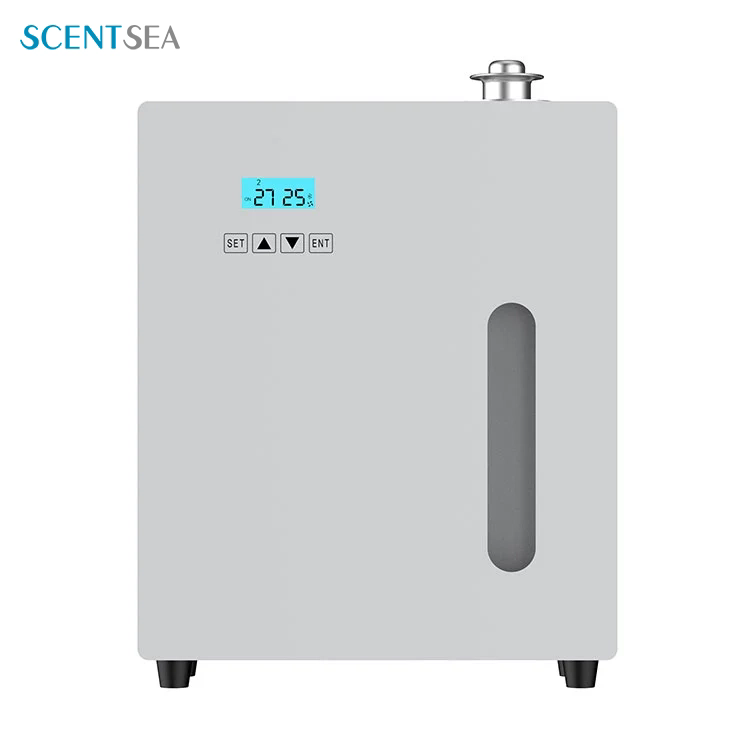
In our factory, cold-air nebulization is the core technology for our commercial range. We use a two-stage air compressor and a precision nozzle to produce a consistent particle size across the operating range. The output is controlled by a programmable timer and a concentration sensor. Shenzhen Scentsea Technology Co., Ltd. provides the particle size test report for each model.
3. Which Operational Factors Matter Most When Comparing Commercial Technologies?
The operational factors determine the monthly cost and the maintenance burden. The coverage area per unit determines how many units are needed for a given space. The oil consumption determines the monthly fragrance cost. The HVAC compatibility determines whether the unit can be connected to the supply duct or must be placed as a stand-alone unit. The maintenance interval determines the labor cost. The noise level determines whether the unit can be placed near guests. The table below compares the four technologies on these factors.
| Operational factor | Cold-air nebulization | Ultrasonic nebulization | Heated evaporation | Passive evaporation |
| Oil consumption (per 1,000 m³ per day) | 2 – 4 ml | 6 – 12 ml | 8 – 15 ml | 3 – 6 ml (but low coverage) |
| HVAC duct connection | Yes (with adapter) | Limited | No | No |
| Maintenance interval | 3 – 6 months | 1 – 2 months | 2 – 3 months | 2 – 4 weeks (oil change) |
| Noise level | 35 – 45 dB | < 30 dB | < 30 dB | None |
| Best suited to | Large lobbies, retail, HVAC | Small rooms, clinics | Small retail, budget projects | Residential, small offices |
Facility brand manager's note: The oil consumption is not the only cost. The maintenance interval matters more in a multi-site operation. A technology that needs monthly maintenance across 50 sites costs far more in labor than a technology that needs maintenance every 6 months. In our factory, we recommend cold-air nebulization for large commercial spaces and for any site where the unit will be connected to the HVAC system. We recommend ultrasonic for small rooms where the oil film is not a concern. Shenzhen Scentsea Technology Co., Ltd. provides a total cost of ownership calculator for multi-site projects.
4. Why Do Maintenance and Oil Compatibility Decide Whether a Scent Diffuser Machine Survives Commercial Duty?
A commercial Scent Diffuser Machine runs continuously for 12 to 24 hours per day. The compressor, the nozzle, the valve, and the pump are subject to wear. The fragrance oil itself affects the wear. Oils with a high resin content or a high viscosity can clog the nozzle and the valve. Oils with a high alcohol content can attack the seals. The maintenance interval and the cleaning procedure must be matched to the oil. In our factory, we test each model with a range of oil viscosities and resin contents. We measure the nozzle life and the valve life under continuous operation. The results are used to set the recommended maintenance interval and the cleaning procedure. Shenzhen Scentsea Technology Co., Ltd. provides a list of compatible oil suppliers and a cleaning kit with each commercial unit.
We also recommend that the facility team keep a maintenance log for each unit. The log records the oil type, the output setting, the cleaning date, and any nozzle replacement. The log allows the team to identify a recurring clog before it becomes a guest complaint.
5. How Should Buyers Specify and Verify a Diffusion Technology for a Commercial Project?
The specification should include six items. The first is the coverage area and the air change rate. The second is the target concentration in the space. The third is the oil type and the viscosity. The fourth is the HVAC connection requirement. The fifth is the maintenance interval and the cleaning procedure. The sixth is the noise limit. The verification should include four checks. The first is a site concentration measurement at three points in the space. The second is a continuous run test over 72 hours. The third is an oil consumption measurement. The fourth is a noise measurement. In our factory, we perform these checks during commissioning and provide the commissioning report with the unit. Shenzhen Scentsea Technology Co., Ltd. also offers a remote monitoring option that reports the oil level and the output status to the facility team.
We recommend that the buyer avoid selecting the technology by the coverage number alone. A unit that is rated for 1,000 cubic meters in a closed room may not cover the same volume in a space with a high air change rate. The coverage must be calculated from the air change rate and the target concentration.
Frequently Asked Questions About Diffusion Technologies for Commercial Scent Diffuser Machines
Summary for Facility Brand Managers and Project Designers
The diffusion method of a Scent Diffuser Machine determines the particle size, the coverage, the concentration control, and the maintenance cost. Cold-air nebulization produces a fine dry mist that distributes evenly and does not leave an oil film, which makes it the preferred method for large commercial spaces and HVAC ducting. Ultrasonic nebulization is suited to small rooms but leaves an oil film. Heated evaporation alters the fragrance and is suited to budget projects. Passive evaporation provides a low and uncontrolled output. The buyer should specify the coverage by air change rate, the oil type, the HVAC connection, and the maintenance interval, and should verify the concentration at commissioning. Shenzhen Scentsea Technology Co., Ltd. has been manufacturing scent diffuser machines for over 10 years and provides full technology selection and commissioning support for our customers.