

A shower slide bar is a practical bathroom accessory that makes handheld showerheads easier to adjust, improves showering comfort, and helps accommodate different users. However, choosing the wrong size, mounting system, finish, or showerhead holder can lead to installation difficulties and everyday inconvenience. This guide explains how shower slide bars work, which features matter most, how to select compatible components, and how to maintain long-term performance in residential and commercial bathrooms.
What Is a Shower Slide Bar?
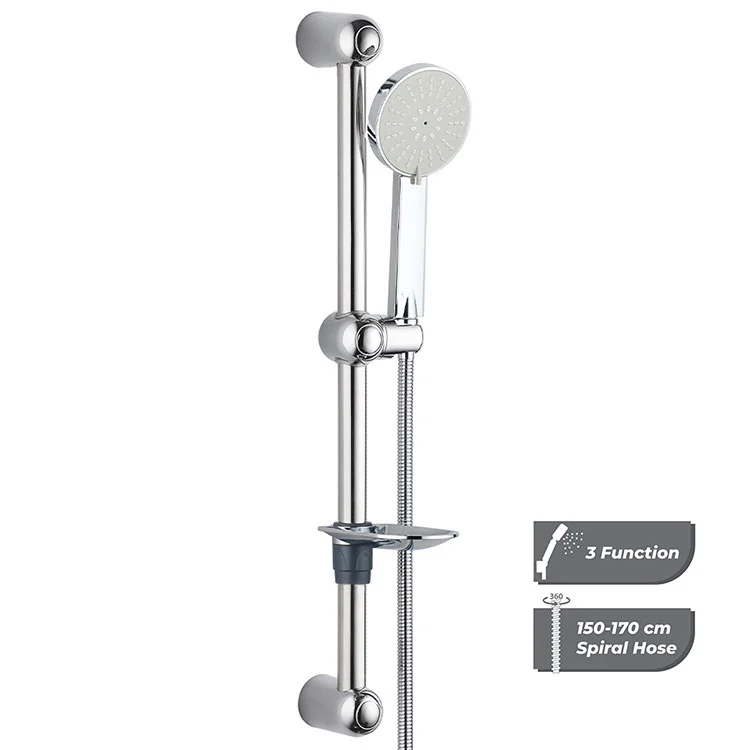
A shower slide bar is a vertical or occasionally angled rail mounted on a shower wall. It carries an adjustable holder that allows a handheld showerhead to move up or down, making it easier to position the spray at a comfortable height. Depending on the design, the assembly may include mounting brackets, a sliding holder, and additional accessories such as a soap dish.
Unlike a fixed showerhead, which remains in one position, a handheld showerhead attached to a slide bar can be adjusted for different users and showering activities. A taller adult can position the holder higher, while a shorter user can lower it without changing the plumbing connection.
Shower slide bars are available in various lengths, profiles, finishes, and mounting configurations. Some are designed as simple functional rails, while others form part of a coordinated shower system with matching faucets, hoses, and handheld showerheads.
Why Does a Shower Slide Bar Matter?
Bathroom accessories are sometimes selected only after the main plumbing fixtures have been installed. However, the shower slide bar can significantly affect daily comfort, accessibility, and the overall usability of a shower enclosure.
1. Adjustable Height for Different Users
Households often include people of different heights. An adjustable holder makes it easier to position a handheld showerhead without requiring every user to compromise on comfort. This feature is especially useful in family bathrooms, guest bathrooms, and shared accommodation.
2. Greater Flexibility During Showering
A handheld showerhead can be removed from its holder when necessary and returned to a convenient position afterward. The slide bar provides a consistent reference point for adjusting the spray height, making everyday showering tasks more manageable.
3. Support for Accessibility-Focused Bathrooms
In bathrooms designed around changing mobility needs, an adjustable handheld showerhead can provide additional flexibility. A properly positioned slide bar may make showering easier for seated users or people who prefer not to reach a high fixed showerhead.
However, a standard shower slide bar is not automatically a safety grab bar. Unless a product is specifically designed, tested, and rated for load-bearing use, it should not be used to support body weight. Accessibility projects should also consider appropriate grab bars, seating, reachable controls, and local building requirements.
4. A More Coordinated Bathroom Appearance
Modern slide bars are available in finishes that complement other bathroom fixtures. Matching the rail with the faucet, shower hose, and handheld showerhead can create a more unified appearance without requiring a major bathroom renovation.
5. Practical Value for Renovation Projects
When an existing shower system already supports a handheld showerhead, adding a compatible slide bar may improve usability without changing the entire installation. The feasibility depends on the existing plumbing, wall construction, mounting points, and the new product's specifications.
What Types of Shower Slide Bars Are Available?
Understanding the main design categories helps buyers compare products according to installation conditions, user requirements, and project budgets.
Standard Adjustable Slide Bars
Standard models feature a rail with a movable showerhead holder. They are suitable for many residential bathrooms and are generally selected for straightforward functionality, ease of use, and compatibility with a handheld shower system.
Slide Bars with Integrated Accessories
Some models include a soap dish, storage shelf, or other small accessory. These designs can help keep essential shower products within reach, although the additional components should not interfere with the holder's movement or cleaning access.
Concealed-Fixing Designs
Concealed-fixing slide bars use mounting arrangements that minimize the visibility of screws or other hardware. They can create a cleaner appearance, but installation may require careful measurement and access to the appropriate fixing points.
Decorative and Premium Designs
Premium models may feature distinctive rail profiles, coordinated finishes, or upgraded holder mechanisms. These options can be appropriate for hospitality projects, contemporary homes, and bathrooms where visual consistency is important.
| Design Type | Main Advantage | Consideration |
|---|---|---|
| Standard adjustable | Practical and straightforward | Check rail length and holder compatibility |
| Integrated accessories | Additional everyday convenience | Consider cleaning access and available space |
| Concealed fixing | Cleaner visual appearance | Requires accurate mounting measurements |
| Premium decorative | Coordinated bathroom styling | Confirm finish durability and replacement parts |
The best design is not necessarily the most complicated one. A well-made, easy-to-adjust slide bar that fits the shower system and installation environment is often more useful than a visually impressive product with limited compatibility.
Which Materials and Finishes Should Buyers Consider?
A shower slide bar operates in a humid environment and is regularly exposed to water, soap, cleaning products, and temperature changes. Material selection and surface treatment therefore influence its appearance, maintenance requirements, and expected service life.
Stainless Steel
Stainless steel is commonly considered for bathroom accessories because of its corrosion resistance and clean appearance. Performance depends on the specific grade, manufacturing quality, surface condition, and exposure environment. Buyers should confirm the actual material specification rather than relying on the term "stainless steel" alone.
Brass Components
Brass may be used in mounting components, fittings, or other parts of a shower accessory. Its suitability depends on the alloy, component design, and surface treatment. A product can combine different materials, so it is useful to ask suppliers for a component-level material breakdown.
Aluminum Alloys
Aluminum can offer a relatively lightweight structure and may be suitable for particular rail designs. Surface treatment is important for appearance and resistance to the conditions encountered in a bathroom.
Engineering Plastics
Engineering plastics may be used in sliding holders, adjustment knobs, end caps, and accessory components. Their quality affects friction, movement, fit, and resistance to repeated use. Plastic components should be evaluated for their intended application rather than judged by appearance alone.
Popular Surface Finishes
- Chrome: A versatile, reflective finish that pairs well with many traditional and contemporary fixtures.
- Brushed nickel: A softer metallic appearance that can help reduce the visibility of some everyday marks.
- Matte black: A strong visual accent for modern bathrooms, although cleaning instructions should be followed carefully.
- Brushed or polished stainless steel: A restrained metallic appearance suitable for many functional and minimalist interiors.
- Brushed gold or other decorative finishes: Options for coordinated premium bathroom designs, subject to the supplier's finish specifications.
Finish names alone do not establish durability. Ask about the coating or finishing process, corrosion testing, cleaning restrictions, and consistency between production batches when evaluating products for a larger project.
How Can You Choose the Right Shower Slide Bar?
The right shower slide bar should fit the available space, support the intended users, work with the showerhead and hose, and match the expected maintenance level. The following factors provide a practical starting point.
1. Measure the Available Installation Space
Measure the intended mounting area before selecting a rail. Consider the distance between the fixing points, the usable sliding range, the position of nearby controls, and the clearance required for the showerhead and hose.
A longer rail does not automatically provide better usability. The effective adjustment range also depends on the holder design, end stops, mounting position, and the user's reach.
2. Check the Sliding Holder
The holder is one of the most important functional components. It should move smoothly, remain secure at the selected height, and be easy to adjust without excessive force. If possible, inspect how the locking mechanism operates and whether it can be adjusted comfortably with wet hands.
3. Confirm Showerhead and Hose Compatibility
Not every handheld showerhead fits every holder. Compare the showerhead handle dimensions, holder opening, adjustment mechanism, and hose length. The hose should reach the intended positions without excessive tension, kinking, or contact with sharp edges.
4. Match the Material to the Project
For residential use, buyers may prioritize appearance, ease of cleaning, and dependable everyday adjustment. Hotels, serviced apartments, and other high-use environments may place greater emphasis on consistent production quality, replaceable components, and maintenance efficiency.
5. Consider the Intended Users
In family bathrooms, a broad adjustment range may be especially useful. For accessible bathrooms, evaluate the complete layout rather than the rail alone. In rental properties, simple operation and straightforward cleaning may be more important than decorative features.
6. Review Product Documentation
Before purchasing, request product drawings, dimensions, material details, installation instructions, and applicable test information. For commercial orders, also clarify packaging, quality inspection procedures, spare-part availability, and warranty terms.
What Compatibility Issues Should You Check Before Installation?
A product may appear suitable in a catalog but still prove difficult to install if its dimensions or mounting requirements do not match the bathroom. Checking the installation environment in advance can prevent unnecessary drilling, replacement costs, and delays.
- Rail dimensions: Verify the total length, mounting-point spacing, and usable travel of the holder.
- Wall construction: Determine whether the mounting surface is tile, masonry, timber framing, or another material.
- Fixing method: Check whether the supplied screws, anchors, or other mounting hardware suit the actual wall conditions.
- Existing holes: Compare the new mounting pattern with existing holes if replacing an older slide bar.
- Showerhead holder: Confirm that the holder accommodates the handle dimensions and intended adjustment range.
- Hose movement: Make sure the hose can move freely without catching on the rail, controls, or enclosure.
- Water exposure: Consider splash zones, drainage, and the supplier's cleaning and maintenance recommendations.
Adhesive-mounted or no-drill alternatives may be available for certain products, but their suitability depends on the specific design, surface preparation, and manufacturer's stated limitations. Do not assume that an adhesive solution can support every rail or withstand every installation condition.
How Should a Shower Slide Bar Be Installed?
Installation procedures vary by model and wall construction. Always follow the manufacturer's instructions for the specific product. The steps below provide a general planning framework rather than a substitute for model-specific instructions.
Step 1: Determine the Mounting Position
Position the rail where users can comfortably reach the adjustment mechanism. Check the expected height range of the handheld showerhead and make sure the rail does not interfere with shower controls, shelves, doors, or other fixtures.
Step 2: Measure and Mark the Fixing Points
Use the product's installation template or measured dimensions to mark the mounting positions. Check alignment carefully before drilling. Even small measurement errors can make it difficult to fit the rail or place the holder at the intended height.
Step 3: Identify the Wall Material
Choose fixing hardware appropriate for the wall construction. Before drilling, confirm that the proposed locations are clear of concealed pipes, electrical wiring, and other services. If the wall structure or hidden services are uncertain, consult a qualified installer.
Step 4: Secure the Mounting Brackets
Install the brackets using the specified hardware and tightening procedure. Avoid excessive force, which may damage tile, deform components, or affect the alignment of the rail.
Step 5: Fit the Rail and Holder
Assemble the slide bar according to the instructions. Check that the rail is stable and that the holder travels smoothly throughout its intended adjustment range.
Step 6: Test the Complete Assembly
Fit the compatible handheld showerhead and hose, then check the holder at different heights. Verify that the showerhead remains secure, the adjustment mechanism works correctly, and the hose moves without obstruction.
Common Installation Mistakes
- Choosing a mounting position before checking the actual adjustment range.
- Assuming existing screw holes will match a replacement product.
- Using wall anchors that are unsuitable for the mounting surface.
- Overtightening fasteners and damaging surrounding finishes.
- Ignoring hose clearance or the dimensions of the handheld showerhead.
- Using a standard slide bar as a grab bar or other body-support device.
How Can You Keep a Shower Slide Bar in Good Condition?
Regular, gentle cleaning helps preserve the appearance of a shower slide bar and makes it easier to identify loose fittings or changes in the holder's movement. Maintenance requirements vary by material and finish.
Clean the Rail Regularly
Wipe the rail with a soft cloth and a cleaning solution approved by the manufacturer. Rinse away residue where appropriate and dry the surface to reduce water spots and mineral deposits.
Avoid Aggressive Cleaning Products
Strong acids, abrasive powders, rough scouring pads, and unapproved solvents can damage decorative finishes. Even when two products look similar, their coating systems may respond differently to cleaning chemicals. Follow the care instructions supplied with the actual product.
Inspect the Holder and Mounting Points
Periodically check whether the holder still moves smoothly and remains in position when adjusted. Look for unusual looseness, visible corrosion, damaged plastic parts, or movement at the mounting brackets. If a component becomes unstable, stop using it until the problem has been assessed and corrected.
Remove Mineral Deposits Carefully
In hard-water areas, mineral deposits may collect around the holder, brackets, and rail ends. Use only a cleaning method suitable for the product's materials and finish. Avoid assuming that acidic descalers are safe for every metal or coating.
Replace Worn Components When Necessary
If the holder no longer locks securely or a component is cracked, check whether the manufacturer provides replacement parts. Replacing a worn component may be more practical than replacing the entire assembly, provided that the remaining parts are in suitable condition.
Where Can Shower Slide Bars Add the Most Value?
Shower slide bars can serve a range of bathroom environments, but the most appropriate design depends on usage frequency, user needs, installation constraints, and the project's maintenance priorities.
Residential Bathrooms
For homes, a slide bar can improve convenience for household members with different heights and showering preferences. Coordinated finishes and compact designs can also help create a more organized bathroom appearance.
Hotels and Hospitality Projects
Hotels and serviced apartments need bathroom accessories that fit a consistent design scheme and are practical to maintain. For these projects, purchasing teams should consider finish consistency, replacement-part availability, installation repeatability, and supplier quality-control procedures.
Rental Properties and Apartment Developments
Rental housing and multi-unit developments often require products that are easy to use and straightforward to maintain. Standardized components may simplify replacement and reduce the variety of spare parts that property managers need to keep available.
Renovation and Bathroom Upgrades
During renovation, a slide bar may be a useful upgrade when the existing shower arrangement already supports a handheld showerhead. Before selecting a replacement, verify the mounting dimensions and whether the existing wall can accommodate the new fixing method.
Accessibility-Oriented Projects
An adjustable handheld showerhead may support more flexible bathing arrangements. However, designers should consider the entire accessible shower environment, including reach ranges, transfer space, seating, water controls, and separately rated grab bars where needed.
What Should Buyers Confirm Before Placing an Order?
For importers, distributors, bathroom brands, and project contractors, product selection is only one part of the purchasing decision. Clear specifications help reduce misunderstandings between the buyer, manufacturer, installer, and end user.
| Evaluation Area | Questions to Ask | Why It Matters |
|---|---|---|
| Dimensions | Are rail length, fixing distance, and holder travel documented? | Helps confirm installation suitability |
| Materials | Are the rail, brackets, and holder materials specified? | Supports informed quality comparisons |
| Surface finish | Are finish options and care instructions available? | Helps coordinate appearance and maintenance |
| Compatibility | Are the intended showerhead and hose dimensions compatible? | Reduces fitting problems |
| Quality control | Are inspection procedures and relevant test records available? | Improves purchasing confidence |
| Packaging | Are product protection, labels, and carton specifications confirmed? | Supports transport and distribution planning |
| After-sales support | Are spare parts, warranty terms, and technical instructions available? | Helps manage long-term service requirements |
| Order requirements | Are minimum quantities, lead times, and customization details clear? | Supports project scheduling and cost planning |
When comparing suppliers, buyers should request verifiable specifications instead of relying exclusively on general claims about premium quality or long service life. Sample evaluation, dimensional checks, and clearly documented acceptance criteria can help establish whether a product meets the project's actual requirements.
For private-label or larger-volume orders, clarify which elements can be customized, such as finish, packaging, product labeling, or selected design details. Confirm feasibility, tooling requirements, minimum order quantities, production lead times, and sample approval procedures before finalizing the order.
Frequently Asked Questions About Shower Slide Bars
1. What is the main purpose of a shower slide bar?
Its main purpose is to let users adjust the height of a handheld showerhead along a rail. This improves convenience for people with different heights and makes it easier to position the showerhead for different showering needs.
2. Are shower slide bars compatible with all handheld showerheads?
No. Compatibility depends on the holder opening, handle dimensions, adjustment mechanism, and sometimes the showerhead's shape and weight. Check the manufacturer's dimensions before purchasing a replacement or combining components from different systems.
3. How high should a shower slide bar be installed?
There is no single height suitable for every bathroom. The mounting position should provide a useful adjustment range for the intended users while avoiding interference with controls, shelves, doors, and other fixtures. Follow the product's installation instructions and consider the full height range of the showerhead.
4. Can a shower slide bar be installed on an existing tiled wall?
Often, yes, provided the wall and mounting method are suitable. The installer must check the tile and substrate, select appropriate fixings, and avoid concealed pipes and electrical services. Existing holes may not align with the new product, so measurements are essential.
5. Can a shower slide bar replace a grab bar?
Not unless the specific product has been expressly designed, tested, and rated for that safety-support function. Most shower slide bars are intended to position a handheld showerhead, not to carry body weight. Use a separately specified grab bar where physical support is required.
6. Which material is best for a shower slide bar?
The best material depends on the application, budget, finish preference, and maintenance requirements. Stainless steel, brass components, aluminum alloys, and engineering plastics can all be suitable for particular parts or designs. Evaluate the actual specifications and manufacturing quality rather than selecting by material name alone.
7. How do you prevent a shower slide bar from becoming loose?
Use the specified fixing hardware, install it according to the manufacturer's instructions, and confirm that the wall can support the mounting arrangement. Inspect the brackets periodically. If the rail becomes loose, identify and correct the cause instead of simply tightening fasteners excessively.
8. How should a matte black shower slide bar be cleaned?
Use a soft cloth and a mild cleaning product approved for the finish. Avoid abrasive pads, harsh chemicals, and unapproved descalers that may scratch or discolor the surface. Follow the manufacturer's maintenance instructions.
9. Can a shower slide bar be customized for a bathroom brand?
Some manufacturers may offer customization options such as selected finishes, packaging, branding, or design details. Available options depend on the product, production capabilities, order quantity, and development requirements. Buyers should request confirmation of feasibility, samples, costs, and lead times before committing to a customized order.
10. What information should be provided when requesting a quotation?
Provide the required dimensions, preferred material and finish, estimated order quantity, intended market, packaging needs, and any branding or customization requirements. If the slide bar must work with an existing showerhead or hose, include the relevant measurements or product drawings to help the supplier evaluate compatibility.
Choosing a Shower Slide Bar That Works for the Long Term
A well-selected shower slide bar can make a bathroom more comfortable, adaptable, and visually consistent. The most important considerations are not simply its appearance or price, but the adjustment range, holder stability, material specifications, mounting requirements, and compatibility with the complete shower system.
For homeowners, careful measurement and straightforward maintenance can help avoid common problems. For contractors, importers, distributors, and bathroom brands, clear product documentation, reliable manufacturing processes, and consistent specifications are essential when evaluating products for larger projects.
Yuyao Nuhu Sanitary Ware Co., Ltd. is a relevant supplier to contact when exploring sanitary ware products and discussing product requirements. Buyers should confirm the company's current shower slide bar range, available specifications, customization capabilities, and order conditions directly before making a purchasing decision.
Looking for a Shower Slide Bar Supplier for Your Next Project?
Whether you are sourcing bathroom accessories for retail distribution, residential developments, hospitality projects, or a private-label product range, choosing the right supplier starts with clear specifications and open communication.
Contact Yuyao Nuhu Sanitary Ware Co., Ltd. to discuss your shower slide bar requirements, request available product information, and explore suitable options for your market. Share your preferred dimensions, materials, finishes, estimated order quantity, and customization needs to help the team assess your project more efficiently.
Ready to take the next step? Contact us to discuss your product requirements and request further information.