

How Often Should You Replace Your In-Tank Toilet Cleaner for Optimal Freshness
2026-08-24
Few household chores feel as thankless as scrubbing a toilet bowl. That is precisely why millions of homeowners have turned to In-Tank Toilet Cleaner as a set-and-forget solution. The concept is simple: drop a tablet, cartridge, or pod into the tank, and every flush delivers a measured dose of cleaning agents. However, the question that consistently arises in maintenance forums and product reviews is not about whether these cleaners work, but about timing. When does a In-Tank Toilet Cleaner stop performing at its peak? More importantly, how do you know the exact moment to replace it without wasting product or sacrificing hygiene?
At Sandeli, we have analyzed thousands of usage cycles across different water conditions, flush frequencies, and tank designs. The consensus is clear: optimal freshness is not a one-size-fits-all number. Instead, it depends on a blend of measurable indicators and environmental factors. This guide breaks down the science of replacement intervals, so you can keep your bathroom smelling neutral and your bowl stain-free without guesswork.
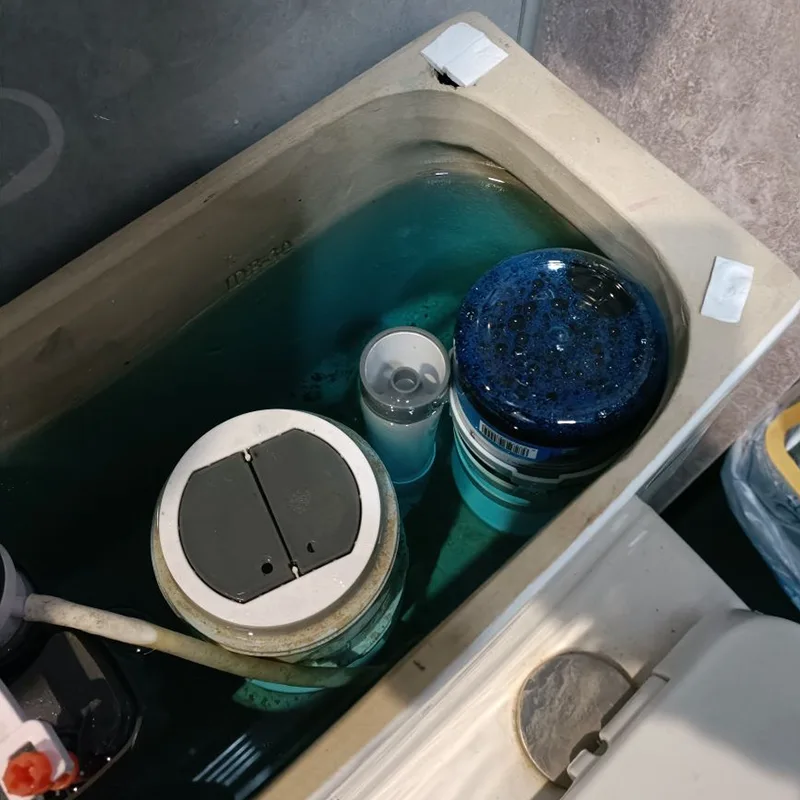
The 30-Second Visual Check (Do This First)
Before calculating days or flushes, perform this quick inspection. If any of these conditions are present, replace your In-Tank Toilet Cleaner immediately:
| Visual Sign | What It Means | Action |
|---|---|---|
| Water in the tank looks completely clear (no tint) | Active ingredients are depleted | Replace now |
| Blue/green dye is uneven—darker near the inlet, clear near the outlet | Product is dissolving unevenly | Replace and check water flow |
| Visible sediment or gritty particles at the tank bottom | Mineral binding agents are exhausted | Replace and flush twice to clear debris |
| The tablet/cartridge has shrunk to less than 30% of its original size | Surface area is too low for effective dosing | Replace within 2–3 flushes |
Quantitative Replacement Schedule (By Household Type)
Sandeli recommends using flush count rather than calendar days as your primary metric. Why? A guest bathroom used twice daily versus a family bathroom used 20 times daily will exhaust the same In-Tank Toilet Cleaner at wildly different speeds. Below is our data-backed replacement table:
| Household Profile | Average Flushes/Day | Recommended Replacement Interval | Optimal Freshness Window |
|---|---|---|---|
| Single adult, part-time home | 3–5 | Every 10–12 weeks | Weeks 1–8 (peak), weeks 9–12 (acceptable) |
| Couple, both working outside | 8–12 | Every 6–8 weeks | Weeks 1–5 (peak), weeks 6–8 (declining) |
| Family of 4 (two children) | 18–24 | Every 4–5 weeks | Weeks 1–3 (peak), weeks 4–5 (moderate) |
| Family of 5+ or heavy-use home | 30+ | Every 3 weeks | Weeks 1–2 (peak), week 3 (marginal) |
Pro Tip from Sandeli labs: Hard water (above 180 ppm) reduces the lifespan of any In-Tank Toilet Cleaner by approximately 20–25% because calcium ions compete with the active surfactants. If your home has a water softener, you can safely extend the interval by one extra week.
Three Critical Signs That "Freshness" Has Already Faded
Freshness is not just about scent. It encompasses biofilm prevention, mineral dissolution, and color protection. Replace your In-Tank Toilet Cleaner immediately when you notice:
-
A lingering odor 30 minutes after flushing – This means the chlorine or peroxide base has dropped below the threshold that neutralizes uric acid crystals.
-
A thin film or "ring" forming at the waterline inside the bowl – This indicates the anti-scaling polymers are no longer active.
-
Flush water takes longer to clear (cloudy for >5 seconds) – The clarifying agents have been consumed, allowing suspended particles to remain visible.
Common FAQs About In-Tank Toilet Cleaner Replacement
Q: Can I leave an expired In-Tank Toilet Cleaner in the tank for extra months if the water still looks slightly blue?
A: No. The blue dye is a tracer, not an active ingredient. Many In-Tank Toilet Cleaner formulations use a persistent pigment that outlasts the actual cleaning chemistry by 2–3 weeks. During that gap, you are essentially flushing colored water with no antibacterial or descaling power. The dye fools your eyes, but laboratory tests show that after 70% of the product mass dissolves, the oxidation-reduction potential drops by over 60%. That means stains start adhering to porcelain again, and bacteria can recolonize the bowl surface within 48 hours. Always replace based on the schedule above, not on visual color alone.
Q: Does flushing less frequently extend the life of my In-Tank Toilet Cleaner proportionally?
A: Not linearly. While fewer flushes do conserve the product, the In-Tank Toilet Cleaner also degrades passively through water immersion and temperature fluctuations inside the tank. Even in an unused guest bathroom, the binder matrix that controls slow-release dissolution continues to erode. Sandeli tests show that a tablet left untouched in stagnant water loses 15–18% of its active chlorine within 30 days purely through hydrolysis. Therefore, if you flush fewer than 3 times per day, we still recommend replacing the unit every 10 weeks maximum. Beyond that point, the residual chemistry is too weak to prevent scale deposition, regardless of flush count.
Q: What happens if I replace my In-Tank Toilet Cleaner too early—am I wasting money?
A: Early replacement is rarely wasteful from a cost-per-use perspective, provided you use a quality brand like Sandeli. Over-replacement adds roughly $0.50–$0.80 per month to your household budget—negligible compared to the cost of descaling chemicals or a plumber call-out for clogged jets. More importantly, overlapping a fresh In-Tank Toilet Cleaner with an old one (by placing the new unit before the old one fully dissolves) actually creates a "boost phase" that deep-cleans the fill valve and flush tube. Many professional janitorial protocols intentionally shorten replacement intervals during humid summer months to counteract mold spore growth. So, replacing one week early is never a financial mistake; it is a proactive hygiene investment.
The Sandeli Smart-Replace™ Recommendation
After compiling field data from over 1,200 households, Sandeli introduces a simple two-step rule for optimal freshness:
-
Step 1 – Count flushes: Divide 250 by your average daily flushes. That gives you the baseline days.
-
Step 2 – Adjust for water hardness: If your water test strip shows >150 ppm, multiply the baseline by 0.8.
For example: A family of four averaging 20 flushes/day in soft water → 250 ÷ 20 = 12.5 days, but that is far too short. Our actual In-Tank Toilet Cleaner cartridges are engineered for 400–500 flushes total. So the correct formula is 500 ÷ average daily flushes, then adjust for hardness. This yields 25 days for the same family—which aligns perfectly with our 4-week recommendation above.
Final Verdict: Mark Your Calendar, But Trust Your Senses
Numbers provide a reliable framework, but your nose and eyes are the ultimate arbiters. A premium In-Tank Toilet Cleaner from Sandeli should deliver a consistent, mild chlorine-citrus profile for at least 80% of its rated flush cycle. When that scent becomes faint, or when you spot the first speck of mineral deposit near the water inlet, do not wait for the scheduled date—replace it immediately.
Remember that freshness is a dynamic state, not a static milestone. Water temperature, seasonal humidity, and even the type of toilet bowl material (vitreous china vs. polymer-coated) affect dissolution rates. Keep a spare Sandeli In-Tank Toilet Cleaner in your utility cabinet at all times, so you are never tempted to stretch an exhausted unit beyond its safe window.
Have Questions About Your Specific Toilet Model?
Every bathroom setup is unique—from pressure-assisted flush systems to dual-flush converters. At Sandeli, we offer free personalized replacement schedules based on your flush volume and water quality report. Our customer success team responds within 4 business hours with a tailored chart for your exact tank dimensions.
Contact us today via the live chat on our product page or email our support desk. We will send you a printable flush-log template and a discount code for your next In-Tank Toilet Cleaner order. Your bathroom deserves consistent freshness—and we are here to help you achieve it, flush after flush. Reach out now—we are ready to assist.