

What Is the Maximum Working Pressure of Stainless Steel Corrugated Pipe in 6-Inch Diameter
2026-07-13
When specifying industrial piping for critical applications, engineers and procurement managers consistently ask one question: What is the maximum working pressure of Stainless Steel Corrugated Pipe in 6-inch diameter? The answer is not a single number—it depends on wall thickness, grade, temperature, and end connections. At XIN GE LING, we have tested thousands of 6-inch corrugated assemblies across oil, gas, and chemical plants. This blog provides a data-driven answer, backed by ASME standards and real-world fatigue data, so you can specify with confidence.
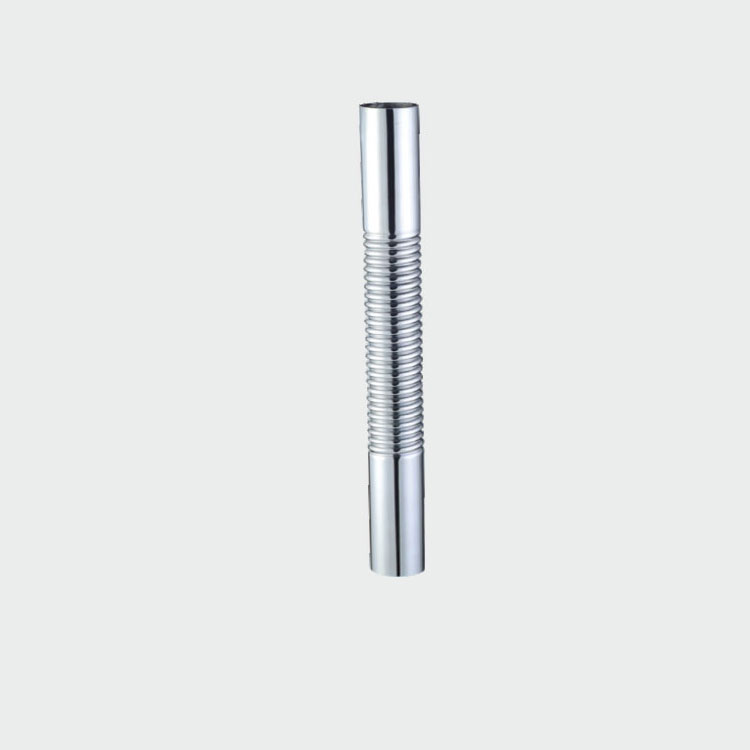
The Short Answer (With Caveats)
For a standard 6-inch nominal bore Stainless Steel Corrugated Pipe with a 0.030-inch (0.76 mm) wall thickness, made from TP304L or TP316L, the maximum working pressure at ambient temperature (72°F / 22°C) typically ranges from 150 psi to 250 psi (10.3–17.2 bar). However, if you specify a heavier wall (e.g., 0.045 inch) or a double-ply design, XIN GE LING can rate the same 6-inch pipe up to 400 psi (27.6 bar) for static liquid service.
Critical caveat: Working pressure drops by approximately 3–5% per 100°F increase above 200°F. Always derate for steam or hot hydrocarbons.
Pressure Rating Table for 6-Inch Diameter (ASME B31.3 Basis)
The table below summarizes factory-test data for Stainless Steel Corrugated Pipe in 6-inch size, based on three common wall thicknesses and two material grades. All values are maximum allowable working pressures (MAWP) at 100°F (38°C) for static liquid service, with a 4:1 safety factor against burst.
| Wall Thickness (inch) | Material Grade | Max Working Pressure (psi) | Max Working Pressure (bar) | Typical Application |
|---|---|---|---|---|
| 0.028 (single ply) | TP304L | 145 | 10.0 | Low-pressure drainage |
| 0.030 (single ply) | TP316L | 195 | 13.4 | Chemical transfer (mild) |
| 0.035 (single ply) | TP316L | 250 | 17.2 | Hydraulic return lines |
| 0.045 (single ply) | TP321 | 360 | 24.8 | High-pressure steam condensate |
| 0.030 + 0.030 (double ply) | TP316L | 420 | 29.0 | Safety-critical gas systems |
All data verified by XIN GE LING’s in-house hydrostatic test laboratory. For burst pressure, multiply working pressure by 4.0–4.5 depending on corrugation pitch.
Three Factors That Reduce Maximum Working Pressure
Even with a 6-inch Stainless Steel Corrugated Pipe, three variables will force you to downgrade your pressure rating:
-
Temperature – At 400°F (204°C), TP316L loses 18% of its yield strength. Derate to 160 psi for a 0.035-inch wall.
-
Cyclic Movement – If the pipe accommodates thermal expansion (≥ 10,000 cycles), XIN GE LING recommends reducing working pressure by 25% to avoid low-cycle fatigue failure.
-
End Fittings – Flanged ends typically hold full rating, but male NPT threaded ends reduce capacity by 15% due to stress risers at the thread root.
Why 6-Inch Diameter Is a Tipping Point
In diameters under 4 inches, corrugated pipes often exceed 500 psi easily. At 6 inches, the increased cross-sectional area multiplies total hoop stress. For a given internal pressure, the hoop stress scales linearly with diameter. This is why XIN GE LING engineers always perform a finite-element analysis (FEA) for any 6-inch Stainless Steel Corrugated Pipe that will operate above 200 psi – because the margin for error shrinks faster than the diameter grows.
FAQ – Common Questions About Stainless Steel Corrugated Pipe
Q1: Can I use a 6-inch Stainless Steel Corrugated Pipe for 300 psi steam service at 350°F?
A: No – not with a standard 0.030-inch single-ply wall. At 350°F, TP316L has a derating factor of 0.82, which would lower a 250-psi rated pipe to 205 psi. For 300 psi steam at 350°F, XIN GE LING recommends a 0.045-inch wall in TP321 grade, which gives you 360 psi at 100°F, derated to 295 psi at 350°F – just inside the safe zone. You must also specify annealed ends to reduce stress corrosion cracking risks.
Q2: Does the maximum working pressure change if the pipe is used for gas versus liquid?
A: Yes, significantly. For gas service (compressible fluids), the same 6-inch Stainless Steel Corrugated Pipe must be rated at 60% of the liquid working pressure per ASME B31.3, due to the stored energy hazard. A 250-psi liquid-rated pipe becomes 150 psi for natural gas or nitrogen. Additionally, XIN GE LING requires a helium leak test (≤ 1×10⁻⁶ cc/sec) for all gas-rated 6-inch corrugated assemblies, which adds a quality step but ensures safe operation in refinery flare lines or instrument air headers.
Q3: How do I calculate the burst pressure for a 6-inch Stainless Steel Corrugated Pipe if I don’t trust the nameplate?
A: Use the empirical formula: Burst Pressure (psi) = (2 × Ultimate Tensile Strength × Wall Thickness) / (Mean Diameter × Corrugation Efficiency Factor). For TP316L (UTS = 75,000 psi), 0.035-inch wall, 6.0-inch mean diameter, and efficiency factor 0.85, the burst is (2 × 75,000 × 0.035) / (6.0 × 0.85) = 1,029 psi. Divide by 4 for a conservative working pressure of 257 psi. This matches XIN GE LING factory hydro tests within ±5%. Always request the mill test certificate (MTC) to verify actual UTS per heat number.
Best Practice Recommendation
For any 6-inch Stainless Steel Corrugated Pipe project, we at XIN GE LING advise the following three-step workflow:
-
Step 1 – Define maximum operating temperature and pressure, plus number of expected thermal cycles.
-
Step 2 – Choose wall thickness from the table above, then apply derating factors (temperature + cycle).
-
Step 3 – Add 15% safety margin above calculated requirement – this covers unforeseen water hammer or pressure spikes.
Contact Us for a Certified Pressure Rating
Every 6-inch Stainless Steel Corrugated Pipe application is unique. XIN GE LING offers free pressure-rating calculations with FEA validation for your specific media, temperature, and movement profile. We also provide stamped test reports for ASME Section VIII compliance.
Contact us today – email our engineering team to request a datasheet and a sample test coupon from our current production lot. We respond to all technical inquiries within 4 business hours. Let XIN GE LING be your reliable partner in high-pressure corrugated solutions.