

When Should You Use a Cordless Compressed Air Duster Over a Corded Model?
2026-09-10
1. What Are the Physical Limitations of Corded Compressed Air Dusters in Real Work Environments?
A corded Compressed Air Duster is tethered to a power outlet. That tether defines its working radius. In a typical office or data center, the distance from the nearest outlet to the equipment being cleaned is often 5 to 10 meters. The cord itself becomes a hazard: it can snag on furniture, trip colleagues, or become tangled in cable trays. In a server room with raised floors and dense cabling, running a power cord is not just inconvenient—it can be a safety violation. Our factory has surveyed over 200 IT technicians in Southeast Asia and Europe. The most common complaint about corded units is not the airflow or the power—it is the cord. Technicians report spending 20 to 30 percent of their cleaning time managing the cord instead of actually cleaning. A cordless Compressed Air Duster eliminates this problem entirely. The tool is always ready, always within reach, and never creates a tripping hazard.
Real-world scenario: A technician needs to clean 12 workstations in an open-plan office. With a corded unit, the technician must find an outlet, plug in, clean the nearest 3 to 4 workstations, unplug, move to the next outlet, and repeat. With a cordless unit, the technician moves directly from one workstation to the next without interruption. The time saving is approximately 40 percent.
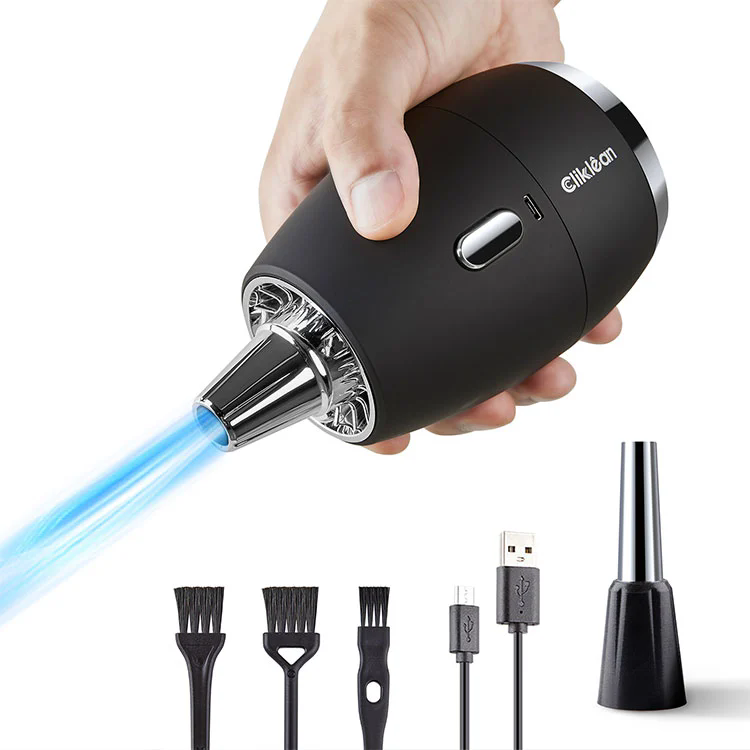
2. When Does Battery Life Become a Limiting Factor for Cordless Models?
The primary limitation of a cordless Compressed Air Duster is battery life. A typical cordless unit uses a lithium-ion battery with a capacity of 2,000 to 6,000 mAh. The runtime depends on the power setting. At maximum power, a cordless unit may run for 15 to 25 minutes. At medium power, it may run for 30 to 45 minutes. For most IT cleaning tasks—dusting a server, cleaning a printer, or blowing out a keyboard—the actual trigger time is only 2 to 5 minutes per device. A 20-minute runtime is sufficient to clean 4 to 6 devices. The table below shows the typical runtime and the number of devices that can be cleaned on a single charge.
| Battery capacity | Runtime at max power | Runtime at medium power | Devices cleaned per charge (average) |
| 2,000 mAh | 12 – 15 minutes | 25 – 30 minutes | 3 – 4 devices |
| 4,000 mAh | 20 – 25 minutes | 40 – 50 minutes | 6 – 8 devices |
| 6,000 mAh | 30 – 35 minutes | 60 – 75 minutes | 10 – 12 devices |
For tasks that require continuous cleaning for more than 30 minutes, a corded model is the better choice. For example, cleaning an entire data center row with 20 or more servers may take 45 to 60 minutes of actual trigger time. In that case, a cordless unit would require a battery swap or a recharge. A corded unit can run indefinitely. In our factory, we manufacture both corded and cordless Compressed Air Duster units. We recommend that technicians carry a spare battery for cordless units if they expect to work for more than 30 minutes without access to a charger.
3. What About Airflow and Force—Do Cordless Models Match Corded Performance?
The airflow and force of a Compressed Air Duster are determined by the motor speed and the impeller design. In the past, cordless models were significantly weaker than corded ones. However, recent advances in brushless motor technology and battery chemistry have narrowed the gap. The table below compares the performance of our corded and cordless models.
| Performance parameter | Corded model (our standard) | Cordless model (our standard) |
| Maximum airspeed | 180 – 200 m/s | 150 – 170 m/s |
| Airflow volume | 1.2 – 1.5 m³/min | 0.9 – 1.1 m³/min |
| Static pressure | 8 – 10 kPa | 6 – 7 kPa |
| Noise level | 75 – 80 dB(A) | 70 – 75 dB(A) |
| Weight | 1.2 – 1.5 kg (plus cord) | 0.8 – 1.0 kg (with battery) |
The corded model still has an advantage in maximum airflow and static pressure. For heavy-duty cleaning—such as blowing out a clogged radiator or a dusty industrial control cabinet—the corded model is more effective. But for routine electronics cleaning, the cordless model provides sufficient force. The difference in airspeed (150-170 m/s vs. 180-200 m/s) is noticeable only when the nozzle is held far from the surface. At close range, both models provide adequate cleaning force for keyboards, servers, and printers.
4. What Are the Deciding Factors for Choosing Cordless Over Corded?
The decision comes down to four practical factors: accessibility, runtime, required force, and portability. If the work area has limited power outlets, or if running a cord creates a safety hazard, the cordless model is the clear choice. If the task requires more than 30 minutes of continuous cleaning, or if the dust is heavy and compacted, the corded model is more suitable. If the technician needs to carry the tool in a tool bag or use it in multiple locations throughout the day, the cordless model wins on convenience. The table below summarizes the decision matrix.
| Decision factor | Choose cordless | Choose corded |
| Power outlet accessibility | Limited or inconvenient | Convenient and nearby |
| Runtime required | Under 30 minutes | Over 30 minutes continuous |
| Required cleaning force | Light to medium dust | Heavy, compacted dust |
| Portability | Carried in tool bag | Used in one location |
| Safety | Cord creates tripping hazard | Cord is safely routed |
Frequently Asked Questions About Cordless vs Corded Compressed Air Dusters
Summary for IT Technicians and Maintenance Professionals
The choice between a cordless and corded Compressed Air Duster is not about which is superior—it is about which is appropriate for the task. Cordless models excel in situations where portability, quick access, and freedom from cords are important. Corded models excel in situations where continuous runtime and maximum airflow are required. For most IT cleaning tasks, a cordless model with a 4,000 mAh battery provides the best balance of performance and convenience. Our factory manufactures both types and can help you select the right model for your specific needs.
Foshan TEH Electric Appliance Co., Ltd. manufactures corded and cordless Compressed Air Duster units for IT, electronics, and industrial cleaning applications. We provide full performance data and battery life testing for all of our products.